Showing posts with label winter squash. Show all posts

Monday, September 13, 2010

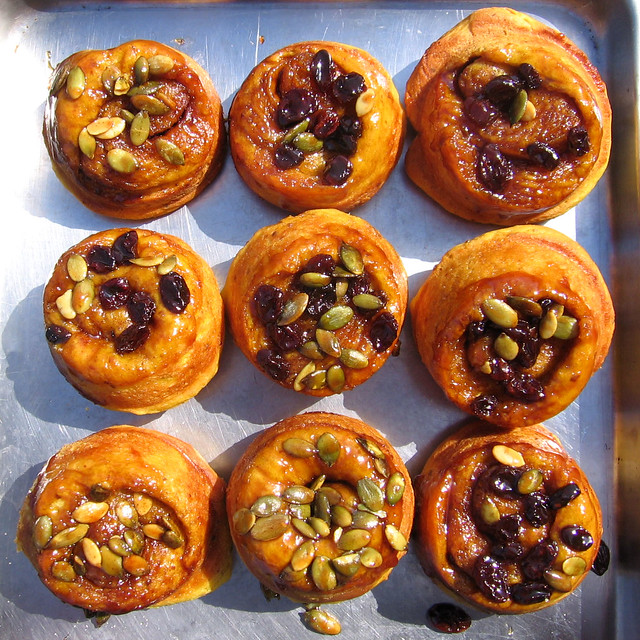
Pumpkin Sticky Buns - vegan

In honor of those who are leaving the area before the start of our gorgeous, crunchy, chilly, squash-filled fall, I present the perfect autumn bruncheon fare. It may seem to be a terribly involved recipe, given the multiparagraph directions, but it's really quite simple once you get going.

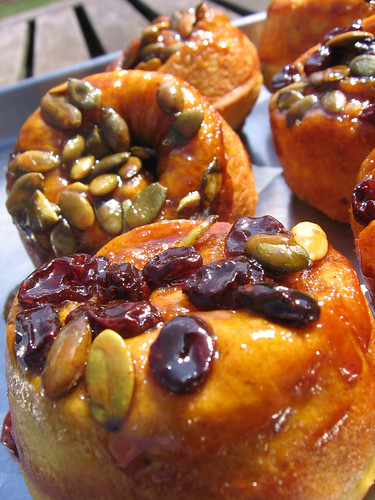
pumpkin stickybuns

Pumpkin Sticky Buns
makes one dozen buns

for the dough
.5 C WWW flour
2 t yeast
.5 C water, 110ºF

2 C AP flour
.75 C pumpkin puree*
2 T sugar
2 T non-hydrogenated margarine, melted
1 T canola oil
1 T flaxseed meal
1 t salt

1-2 C AP flour for addition and dusting

*in my case the Jarrahdale puree I made and froze last year

for the filling
2 T non-hydrogenated margarine, melted
.25 C brown sugar
.5 t ground cinnamon
.25 t ground cloves
pinch nutmeg
pinch ground allspice

for the pans
.25 C non-hydrogenated margarine
.5 C brown sugar
.5 t cinnamon
.25 pepitas, chopped


Combine .5 C water and the WWW flour with the yeast in the bowl of an electric stand mixer and let stand, covered, half an hour to 3 hours.

Fit bowl into mixer and attach dough hook. Add 2 C AP flour, pumpkin puree, sugar, margarine, oil, flax, and salt; mix on medium-low until combined and a soft, tacky dough forms. Turn the dough out onto a lightly floured surface and knead until, about 10-15 minutes, adding more flour to the dough and surface as needed, up to 1 Cup, until the dough is springy and no longer sticky. Form dough into a round and turn to coat lightly in flour. Place the round on a clean plate or sheet pan and cover with a clean, damp tea towel or plastic wrap. Let rise until doubled in bulk, about an hour.

Meanwhile, prepare the filling. Combine all of the filling ingredients except for the margarine in a small bowl and stir to combine. Set aside.

Also, prepare the pans. Cream together the margarine, brown sugar and cinnamon by hand or with an electric mixer. Divide the mixture into each of twelve cups in a standard muffin tin and spread to cover the bottom. Sprinkle pepitas evenly amongst cups.

Turn the dough onto a lightly floured surface and press evenly with knuckles to disrupt and evenly distribute air pockets. Knead the dough briefly and form into a round once more. Cover with towel or plastic wrap and elt rest 5 minutes.

On a lightly floured surface, use a rolling pin to form the dough into a rough rectangle of about 8”x13”, with the long side parallel to your body. Brush the melted margarine over the rectangle, leaving a .75” border on the long side farthest from you. Sprinkle the sugar mixture evenly over the margarine and pat down lightly. Roll the dough tightly away from you so that the edge without the margarine forms the outer seam of the roll; press this seam to seal.

Cut the roll into quarters and each quarter into thirds, forming a total of 12 pieces. Fit the buns into the prepared muffin tin and cover with lightly oiled plastic wrap. Let rise until doubled in bulk, about 20-30 minutes. Meanwhile, preheat the oven to 350ºF.

Remove plastic wrap and bake rolls 30-50 minutes, until the internal temperature of the rolls reaches 180ºF and the tops of the rolls are golden brown*. Remove from oven and immediately invert pan onto wire rack or sheet pan. Allow to cool slightly before serving.

pumpkin stickybuns

Thursday, November 20, 2008

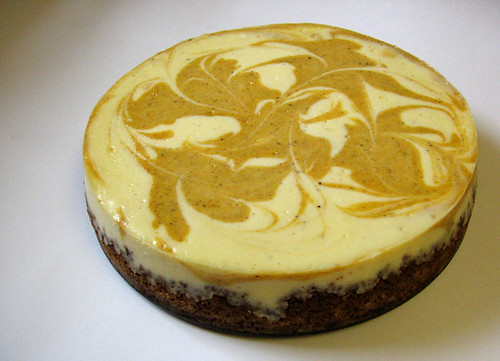
Pumpkin Swirl Cheesecake - Conventional

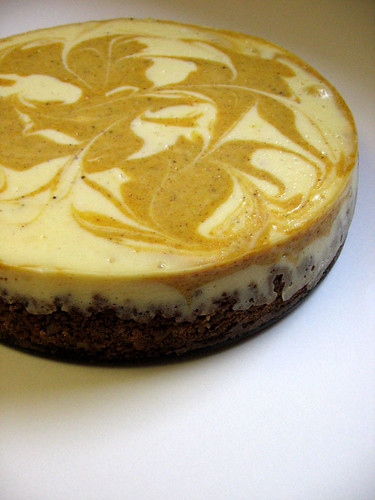
pumpkin swirl cheesecake

Pumpkin Swirl Cheesecake
makes one 9-inch cheesecake
modified from Martha Stewart's Baking Handbook

for the crust:
2 C graham cracker crumbs, fine
.5 C pecans, chopped fine
1/8 t ground allspice
1/8 t ground ginger
1/8 t ground cloves
.25 t ground cinnamon
3 oz unsalted butter

for the filling:

1 C + 2 T granulated sugar
.25 C AP flour
.25 t ground allspice
.25 t ground ginger
1/8 t ground nutmeg
1 t ground cinnamon

.75 C roasted pumpkin/winter squash puree

1.75 lb cream cheese
.5 C sour cream
1 t vanilla extract
2 large eggs
1 large egg yolk

equipment:
9-inch springform pan
roasting pan


Bring all filling ingredients to room temperature. Dairy and eggs may be left out at room temperature for up to 2 hours to bring to temperature.

Preheat oven to 350ºF

make the crust:
In a medium bowl, stir together the cracker crumbs, pecans and spices. Melt butter; pour over crumb mixture and stir to combing. Press mixture into the bottom and up the sides of a 9-inch springform pan. Bake until lightly toasted and fragrant, 10-12 minutes. Let cool completely.

Once cooled, wrap sides and bottom of pan in a double layer of aluminum foil.

make the filling:
Combine spices in a medium bowl. In a small bowl, stir together sugar, flour and a quarter of the spice mixture; set aside. Into the first bowl, stir the pumpkin/winter squash puree until incorporated.

In a large bowl, whip the cream cheese with an electric mixer until fluffy. With mixer on low speed, gradually add the sugar mixture and beat until smooth. Incorporate sour cream and vanilla. Add the eggs and egg yolk, one at a time, beating after each addition just to combine; DO NOT OVERMIX. Scrape down bowl and stir mixture with spatula just to homogenize.

Add 1.5 C filling to the pumpkin mixture and stir to combine.

Pour about .5-inch of plain filling into the cooled crust. Place several large dollops of pumpkin filling around the pan; swirl with a butter knife. Pour remainder of plain filling over swirled filling, covering all visible pumpkin. Dollop remaining pumpkin filling evenly over plain; with a clean butterknife, swirl.

Place pan in the bottom of a large roasting pan. Pour or ladle enough boiling water into pan to come halfway up the side of the cheesecake pan.

Bake in water bath 30 minutes at 350ºF. Reduce oven temperature to 325ºF and continue baking until the center remains jiggly but the edge of the cake is set and just beginning to turn golden brown, about 30-40 minutes. Turn off oven and prop door open with a folded tea towel. Let cool in oven 1 hour before removing to wire rack to cool completely.

Cover and refrigerate overnight before serving, to allow cake to set, flavor to mature.

pumpkin swirl cheesecake

Wednesday, October 8, 2008

Pumpkin Pie Spice Cookies - Vegan

Pumpkin Pie Spice Cookies
makes about 20 cookies

1 C bread flour
.25 C AP flour
.75 C white whole wheat flour
.75 t baking soda
1/8 t salt
1 t ginger
1 t cinnamon
.25 c nutmeg

3/8 C margarine
1/8 C shortening
3/8 C sugar
3/8 C packed light-brown sugar
.25 C pumpkin purée

Creaming method.

Divide dough in two. Between two pieces of parchment paper, roll out half of dough to .25-inch thick. Transfer to a baking sheet and chill for 8 minutes in the freezer. Repeat with remaining half of dough.

Preheat oven to 350º.

Cut dough with a shaped cookie cutter. Transfer shapes to a lined baking sheet. Freeze cookies on sheet for 15 minutes prior to baking.

Bake for 12-16 minutes, until cookies are lightly browned around the edges and puffing is reduced. Cool on pan 3 minutes; transfer to a wire rack to cool completely.

Winter Squah: Jarrahdale

Jarrahdale
Average weight: 12-13 lbs
Excellent for baking.

A large New Zealand pumpkin with a tough blue-green-silver shell. A moderately long keeper - at least 3 months with proper treatment. Sometimes round, sometimes squat, always deeply ridged. The innards are dry and easily removed; the seeds are unusually large and plump.

Raw, the flesh is dry, thick and fine-grained. Roasted, the flesh remains fine and very hearty. Add several tablespoons water to the roasted flesh before processing. Pass through a sieve for optimal texture. Excess water will separate after a few hours of refrigeration.

Steamed, excellent. The dry nature of the flesh agrees with a wet cooking method, steaming by pressure cooker in particular. Some additional liquid may still be necessary to purée.

The sweet, tender flesh is excellent for sweet applications. The rich texture stands up well in soups, gratins and as a dish in and of itself.

Tuesday, September 30, 2008

Pumpkin Pancakes - Vegan

Pumpkin Pancakes
makes 12-16 4-inch pancakes

2 T flaxseed meal
3 T water

1.25 C flour (whole wheat white and white flour blend)
2 T sugar
2 t baking powder
.25 t cinnamon
.25 t ground ginger

.25 t kosher salt
1 1/3 - 1.5 C non-dairy milk
.5 C winter squash purée
1 T vegetable oil

In a small bowl or glass, stir together flaxseed meal and water; set aside while preparing other ingredients.

Whisk together the flour, sugar, baking powder, cinnamon, and ginger in a large bowl; set aside

Whisk together the salt, milk, purée, oil, and flaxseed mixture in a small bowl. Pour the wet ingredients into the dry and stir to combine.

Preheat an oiled skillet or large fry pan for several minutes over medium heat. Dollop batter by the .25-cup onto the hot pan and spread slightly. Cook for 1-2 minutes, until cakes appear dry around the edges. The cakes are ready to flip when the bubbles that erupt in their centers are not immediately refilled with batter. Flip cakes and continue cooking for another 1-2 minutes, until golden-brown.

Eat hot or cool on wire rack before storing in refrigerator or freezer.

Cooking Winter Squash

Cleaning

Prior to each preparation, wash winter squash and pumpkins with warm water and a very small amount of mild soap. Rinse well and dry with a kitchen towel.

Breaking Down

Cutting winter squash is treacherous whether the shell is thick or thin. Work on a solid cutting board with a non-skid footing*; position the board so that you will have a comfortable angle when addressing the squash with your knife. Your first goal is to remove the stem, your second is to halve the squash evenly.

Place the cleaned squash on your board, stem end up. Use a sharp, sturdy chef's knife to pierce the shell near the stem. With force and caution, work the blade into the flesh; remove blade. Rotate the squash about 30 degrees before repeating process. It should take about six repetitions to cut out stem. Set your blade aside before removing stem. It may be necessary to use a sturdy offset spatula or other non-sharp tool to leverage the stem out. The ease with which the stem is removed will be different in each variety, but this step is generally not problematic.

Again, piece the shell at or near the stem hole you've just created. With force and caution, work the blade into the flesh. Taking care to not tip the squash, cut an even line towards the blossom end. Remove blade before turning the squash 180 degrees. Repeat process to cut another line opposite the first. Remove blade before flipping squash so that the blossom end is facing up. Cut to continue lines to their nexus; they should come close to lining up. Set your blade aside before pulling apart the hemispheres of the squash.

Set one half aside while working on the other. Place the hemisphere cut side down on board. Using the same method of caution and force, halve. To break down into eighths, repeat process, this time with skin side on board.

Roasting:

Preheat oven to 400ºF

Halve sqash from stem to blossom. Divide each segment into halves. With a metal or sharp-edged plastic scoop/spoon, scoop stringy pulp and seeds from cavity, reserve in a large bowl. Cut each quarter into halves, keeping pieces as equal as possible.

Lightly oil exposed flesh with vegetable oil or vegetable oil-olive oil blend. Arrange pieces, skin side down, on a half-sheet pan.

Cook for 40-60 minutes, as determined by the variety of squash you are preparing.

Steaming:

Place a steamer insert into a 4 or 6 quart pressure cooker. Pour 1 cup of water into the bottom of the cooker.

Wash and quarter pumpkin and chop into roughly 1.5-inch pieces. Peeling is optional; some squash are easier to peel before cooking, others after.

Arrange pieces as evenly as possible in cooker, not filling the cavity above 2/3 full. Lock lid closed. Over high heat, bring to cooker to high pressure. Maintain high pressure for 3-4 minutes, adjusting burner as necessary.

Quick-release pressure by running water over the closed cooker. Remove lid and test squash - if the flesh is not fork tender, replace lid and lock in place; allow squash to continue to cook in residual heat for another 4-6 minutes.

Remove pieces from cooker and let cool slightly before removing skin and consuming or puréeing.

Puréeing

Wash, break down and roast winter squash. Once squash segments are cool enough to handle, use a large spoon to scoop flesh from skin. Place in the bowl of a food processor or carafe of blender. Process on medium-high speed for several minutes, until even and smooth; it may be necessary to add water to ease the textural transition.

If the flesh is exceptionally stringy, or to achieve a totally smooth texture, pass purée through a sieve before using or storing.

Pour into resealable bags or containers to freeze.

Toasting Seeds:

Place seeds and scooped strings/pulp in a large bowl. Fill partway with water. Press seeds from pulp and discard pulp. Occasionally, stir water briskly to ease this separation. Once the ratio of pulp to seeds is tipped in the favor of the latter, drain bowl through a pasta colander. Scoop seeds back into large bowl and refill partway with water. Repeat squeezing, stirring, drainging until there are very few strings remaining. Drain seeds and spread out on towel-lined sheet pan. Let air dry for 2 hours, sometimes manipulating towel to separate and redistribute seeds.

Preheat oven to 350ºF. Spread dried seeds in an even layer in a rimmed half-sheet pan. Toast, stirring somewhat frequently, until shells are golden-brown and fragrant. Remove sheet from oven. If you so desire, toss hot seeds with kosher salt and a small amount of vegetable oil. Let cool before consuming.

Winter Squash: Long Island Cheese

Long Island Cheese
Average weight: 10-12 lbs
What pumpkin is when it's a vegetable.

A large heirloom pumpkin with a thick, dull pink-orange shell. When properly treated, a very long keeper. The even, squat shape makes the pumpkin easy to store but can complicate seed removal. Large seeds are easy to remove from pulp.

Raw, the sherbet-orange flesh is very moist and stringy. Roasted, the flesh maintains color and body, becomes more smooth with a few small strings. Add a few tablespoons of water to the cooked flesh before whizzing in a food processor.

The barely sweet flesh of this pumpkin is excellent for sweet and savory use.